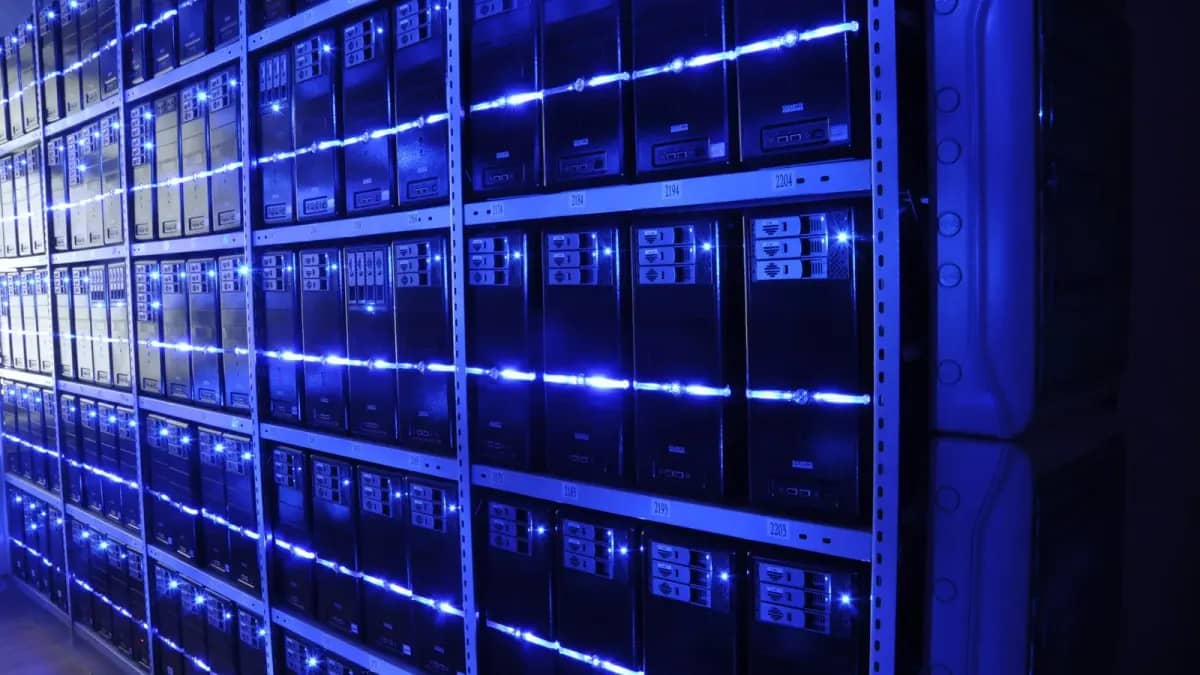
Gemini Passed 1 Billion Users — But the Real Story Is Inference Overtaking Training
Google's Gemini app crossed 1 billion monthly active users. But 2026's genuine inflection is elsewhere: inference spending hit $23.3B and surpassed model training for the first time.
Nova AI News Editor
August 31, 2026 · 6 min read
Google's Gemini app has passed 1 billion monthly active users, marking one of the steepest growth curves in the company's history. At Google I/O in June 2026 the figure was 900 million; the Q2 earnings call cited more than 950 million. The threshold was crossed in August.
But the user count is not the real story here. The real story is what it costs to serve those billion users — and the quiet inversion happening in AI economics.
What is actually behind the number
Gemini's growth is not a standalone app success story. Google's strongest card is distribution:
- Android's built-in assistant layer
- AI overviews in Search results
- Direct embedding into Workspace (Gmail, Docs, Sheets)
- Chrome integrations
Gemini stopped being an app a user has to decide to download and became a feature of products they already use. That is an advantage no competitor can easily replicate.
There is also a detail the company chose not to disclose: the paid subscriber split. How many of those billion monthly users actually pay was left unstated — a deliberate gap that makes the commercial value of the headline hard to assess.
One disclosed figure is more telling than the headline itself: daily active users tripled over the past year. For an assistant product, the conversion from monthly reach into daily habit is the real health metric.
The genuine inflection: inference overtook training
The industry spent three years in a race over who could train the biggest model. In 2026 the equation changed.
According to Gartner, inference spending reached $23.3 billion in 2026, surpassing model training spending for the first time.
That single line means the economic logic of the sector is being rewritten:
- Training is a one-time, large but predictable capital expense.
- Inference is an operating cost repeated on every user request, scaling linearly with usage.
A billion users means billions of daily queries. Every query carries a measurable cost in electricity and hardware amortization on a GPU or TPU. User growth is now directly cost growth.
Google's answer: split the TPU in two
Google pushed that distinction down to the silicon. The eighth-generation TPU family divides into two purpose-built designs:
- TPU 8t — for training
- TPU 8i — for inference
This is more than an engineering footnote. It is an explicit acknowledgment that Google now treats training compute and inference compute as different economic problems.
A training chip is optimized for raw throughput and memory bandwidth. An inference chip is optimized for latency, energy efficiency and cost per request. One piece of silicon cannot excel at both — which is precisely why Google separated them.
The $195-205 billion question
Alphabet raised its 2026 capital spending forecast to between $195 billion and $205 billion, with much of it directed at the infrastructure serving models like Gemini.
For perspective: that figure exceeds the annual budget of many countries. And it is a single company's annual spend on a single technology category.
Two readings follow.
The optimistic read: Google is converting a distribution advantage into a durable infrastructure moat. A company designing its own silicon and running it in its own data centers has a structurally lower cost per request than competitors renting capacity from a cloud provider.
The cautious read: spending at this scale requires a revenue model that scales alongside it. The decision not to disclose the paid subscriber split is conspicuous precisely at this point.
What it means for competitors
Inference cost overtaking training cost changes where the barrier to entry sits.
Three years ago, the obstacle to founding an AI company was the capital to train a frontier model. Today capable open-weight models exist — the obstacle is now the capacity to serve millions of users profitably.
That shifts advantage away from model labs and toward infrastructure owners. Players controlling their own chips, data centers and distribution channels gain a structural edge in cost per request.
Energy: the constraint nobody puts on the slide
Most of the inference-cost conversation is denominated in dollars. But the binding constraint is increasingly electricity.
An AI data center runs at many times the power density of a conventional facility of the same footprint. That creates three new limits:
- Grid capacity. Securing an interconnection agreement for a new site means joining a queue that runs for years in some regions.
- Cooling. For high-density racks, liquid cooling has stopped being an option and become a requirement.
- Siting. Locations with cheap, stable power gain strategic value independent of latency considerations.
This is why the major providers' energy deals get far less coverage than their chip announcements while mattering at least as much. What drives inference cost down is not only better silicon — it is also a cheaper megawatt-hour.
Where the competitors sit
Google's $195-205 billion plan cannot be read in isolation. Every other major player is running infrastructure programs of comparable ambition. The resulting picture is a race in which several companies are spending at historic scale simultaneously.
Three distinct positions are visible in that race:
- Vertically integrated players. Companies designing their own chips, operating their own data centers and owning their own distribution. Google is the clearest example.
- Model-first labs. Players renting infrastructure from a cloud partner, deriving their edge from model quality. Their margins depend on a partner's pricing.
- The open-weight ecosystem. Players distributing models freely and capturing value at other layers. Because they do not absorb inference cost directly, they run on different economics.
In a world where inference has overtaken training, the structural advantage of the first group compounds over time.
The revenue-per-user question
Simple arithmetic shows why this matters. A billion monthly active users implies a base in which free users are the overwhelming majority. Every query from those users generates cost without generating direct revenue.
There are three known ways to close that gap:
- Subscriptions. Without a disclosed conversion rate, the size of this line item is unknown.
- Advertising. Placing ads on an assistant surface is delicate territory for both trust and user experience.
- Enterprise and API revenue. The highest-margin line, but hard-pressed to cover consumer-side cost on its own.
Google's advantage is that it holds all three channels. Its disadvantage is that it also holds the largest scale — which is precisely where the cost side grows fastest.
What to watch
- Will a paid conversion figure be disclosed? Until it is, the commercial value of a billion users remains ambiguous.
- Is cost per inference falling? Distillation, quantization and purpose-built silicon are driving per-request cost down quickly. The slope of that curve sets the industry's profitability timeline.
- Does capex rise again in 2027? The limit of investor patience is embedded in that answer.
A billion Gemini users is an impressive headline. But what will define the next two years of the AI industry is the cost — measured in gigawatts and dollars — of serving them.
Frequently asked questions
How many users does Gemini have? Google says the Gemini app has passed 1 billion monthly active users.
How many of them pay? The company did not disclose the paid subscriber split.
What is inference? Running a trained model to produce a response to a user request. Unlike training, it repeats on every single request.
How large is inference spending? According to Gartner, it reached $23.3 billion in 2026, surpassing model training for the first time.
What is the difference between TPU 8t and TPU 8i? 8t is built for training, 8i for inference. A training chip optimizes for throughput and memory bandwidth; an inference chip optimizes for latency and energy efficiency.
Related Articles
Claude Now Watermarks Every Text It Writes: Is AI Detection Finally Solved?
Since August 2, 2026, Anthropic embeds an invisible watermark in Claude's output. How the SynthID-Text based system works, why the EU AI Act forced it, and the one misreading that will cause real harm.
Read more→
Castle Walls: The First Fully AI-Generated Turkish Series Lands on Prime Video
Ay Yapim's Castle Walls is the first end-to-end AI-generated series to launch on a major streaming platform. How the AYDNA model works, why episodes run only 15 minutes, and what actually changes for the industry.
Read more→
What is on-device AI, and why is it suddenly a core strategy?
Apple's Core AI and Google's Gemini Nano show that in 2026, phones can now run AI without connecting to the cloud. Why is this shift happening, what does it mean for users, and what are the limits?
Read more→Comments
No comments yet — be the first to comment.